Strategic Voting and Election Season Polls

I am linking to a paper of mine (‘Knowledge-Theoretic Properties of Strategic Voting’, co-authored with Eric Pacuit and Rohit Parikh) of possible relevance in the context of the just-decided elections and the importance of election season polling. Here is the abstract. (I am traveling and so unable to write a longer comment at this time).

Results in social choice theory such as the Arrow and Gibbard-Satterthwaite theorems constrain the existence of rational collective decision making procedures in groups of agents. The Gibbard-Satterthwaite theorem says that no voting procedure is strategy-proof. That is, there will always be situations in which it is in a voter’s interest to misrepresent its true preferences i.e., vote strategically. We present some properties of strategic voting and then examine – via a bimodal logic utilizing epistemic and strategizing modalities – the knowledge-theoretic properties of voting situations and note that unless the voter knows that it should vote strategically, and how, i.e., knows what the other voters’ preferences are and which alternate preference P′ it should use, the voter will not strategize. Our results suggest that opinion polls in election situations effectively serve as the first n–1 stages in an n stage election.

This is a technical paper and so unlikely to be readable to plenty of folks so I will try to provide a quick summary and discussion next week. The last sentence of the abstract though, should give you some indication of what its implications are and why they should be of interest to voters, politicians and pollsters alike.

Against Political Speeches, For Political Speech

I’m not sure why I dislike political speeches. By ‘political speeches’ I do not mean ‘political speech’: I am in favor of the latter, the more the better, with some caveats having to do with–among others–Rush Limbaugh, Sean Hannity, Ann Coulter, Karl Rove, Bill O’Reilly, and Sarah Palin. Rather, by ‘political speeches,’ I mean, quite precisely, speeches given by a politician–a party animal, to be exactingly precise–at some political forum: a post-election rally (for victory or concession), a party convention, a campaign rally; these remain resolutely inaccessible to me, a movie show that I can’t sit through. (This definition, should, I hope, make clear that certain species of political speeches in public fora remain impervious to my criticism.)

Along with this dislike goes indifference to political speech hagiography, the admiring dissection of speeches, which elevates them to the level of rhetorical masterpieces. Consider, for instance, Robert Lehrman on Obama’s victory speech on the night of 6th November, comparing it to the 2008 post-election victory speech:

[T]he 2012 model showed all the strengths that Obama and his speechwriters consistently exhibit, producing the best drafts of any president. He used concrete details and repetition (“You’ll hear the determination in the voice of a young field organizer who’s working his way through college … You’ll hear the pride in the voice of a volunteer who’s going door to door…”); antithesis and echoes of John F. Kennedy (“America’s never been about what can be done for us; it’s about what can be done by us together”) and stories that have the ring of truth (“And I saw it just the other day in Mentor, Ohio, where a father told the story of his 8-year-old daughter…”). You also see flashes of wit (“one dog’s probably enough”), and the skillful use of pause, emphasis and variety of tone that makes public speaking teachers like me use him as a model for students. [link in original]

That last sentence reminds me that perhaps the best thing about a ‘good political speech’ these days is that it might serve as a model for those trying to become better public speakers: high-school or college students aspiring to debate club membership, teachers themselves, budding actors, Toastmasters clubs, interviewees, and so on. But I don’t think they shouldn’t copy or emulate everything they see and hear.

Most prominently, because, like almost anyone disillusioned by political speeches in electoral democracies, I see them as heralds of betrayal and disappointment to follow. They are all too often infected by too many promises, too much insincere wheedling. The political speech, now, in this landscape of relentless electioneering, has come to stand for misleading obfuscation, one that serves to obscure the truly political behind a veil of elegant wordsmithing.  This is not necessarily because the speaker–the party political animal, remember–is extraordinarily mendacious, rather it is because he or she is made to appear as a figurehead that misrepresents the forces that are all too often arrayed against those subjected to the speech.

The speech then, comes to serve as beguiling distraction, and not just rallying cry.

A Nation in Identity Crisis?

Just for kicks, I thought it might be interesting, on the day after the 2012 election, to think of the US as a nation undergoing an adolescent identity crisis. I do this in response to some post-election commentary that seems to suggest the demographic shift in the US has engendered one, forcing political parties across the land to respond before their next loss in a national election.

What do we know about identity crises? Well, here are some thoughts from Erik Erikson, who coined the phrase. They sound  especially interesting when the ‘youth’ in question is a nation, and in this case, one with a very particular opinion of itself and its history:

I have called the major crisis of adolescence the identity crisis; it occurs in that period of the life cycle when each youth must forge for himself some central perspective and direction, some working unity, out of the effective remnants of his childhood and the hopes of his anticipated adulthood; he must detect some meaningful resemblance between what he has come to see in himself and what his sharpened awareness tells him others judge and expect him to be. This sounds dangerously like common sense; like all health, however, it is a matter of course only to those who possess it, and appears as a most complex achievement to those who have tasted its absence. Only in ill health does one realize the intricacy of the body; and only in a crisis, individual or historical, does it become obvious what a sensitive combination of interrelated factors the human personality is a combination of capacities created in the distant past and of opportunities divined in the present; a combination of totally unconscious preconditions developed in individual growth and of social conditions created and recreated in the precarious interplay of generations. In some young people, in some classes, at some periods in history, this crisis will be minimal; in other people, classes, and periods, the crisis will be clearly marked off as a critical period, a kind of “second birth,” apt to be aggravated either by widespread neuroticisms or by pervasive ideological unrest. Some young individuals will succumb to this crisis in all manner of neurotic, psychotic, or delinquent behavior; others will resolve it through participation in ideological movements passionately concerned with religion or politics, nature or art. Still others, although suffering and deviating dangerously through what appears to be a prolonged adolescence, eventually come to contribute an original bit to an emerging style of life: the very danger which they have sensed has forced them to mobilize capacities to see and say, to dream and plan, to design and construct, in new ways.

For what it’s worth, I do not think this election, or even the one before it, have triggered anything like an identity crisis. This is not because the US cannot be termed ‘adolescent’; rather, it is because these elections do not seem have induced as fundamental a rupture as indicated above.

Note: Excerpt from Erik H. Erikson, Young Man Luther: A Study in Psychoanalysis and History, W. W. Norton and Company, New York, 1962

Tales of Three Morning Afters

The 2004 Presidential election was my first. I had not voted in the 2000 election because my naturalization came a few weeks too late for me to participate; I had observed the election itself from afar, in Brazil, and watched, amazed by the Supreme Court’s intervention, as the final, lame denouement came about. In 2004, I was cautiously optimistic, hoping that somehow, John Kerry would pull it off. He didn’t; Kerry was never a particularly effective candidate and US voters too, remained bizarrely trusting of the spectacularly mendacious and incompetent erstwhile inhabitant of the White House. I went to a election-result-watching get-together at a friend’s place, ordered Chinese food, and sat down, chopsticks and food cartons at hand, to watch the news. Not too long before midnight, it had become clear Bush was headed for a second term. I left, walking a long, cold walk back home, passing a traffic light that could have looked like a surfer’s greeting but, amazingly enough, that night, looked like it was giving me the bird. The next morning, when I awoke to read of four more years for George Bush, I felt a little sick. I felt guilty too, that my ignoring the Kerry’s campaign’s calls for donations, for help with getting out the vote by phone-banking or door-to-door knocking had somehow contributed to the loss. I couldn’t console myself my inactivity had nothing to do with it.

Four years later, my reactions were very different. I felt I had to contribute somehow–financially or with my time–to blocking any possibility of an extension of the idiocy that had ruled the White House for eight years. The memory of that November 2004 morning was still too strong. I worried I might wake up the day after, convinced I had enabled a John McCain-Sarah Palin White House. I did my bit–sent in money, knocked on doors etc–and after election night, awoke feeling much better than I had four years before.

This election season, I didn’t contribute money to the Obama campaign and I didn’t participate in voter turnout. I did though, fear the same outcomes as I had worried about in the previous two elections. The dissonance in my beliefs about the political monopoly of the Republicans and Democrats, my hopes for a third-party alternative, and my disappointment with Obama’s first four years, had by the end of the evening crystallized into a fairly simple desire: that Obama win, that though no matter how Tweedledum and Tweedledee I considered the two parties, I knew one of the two possible outcomes would upset me much, much more. So by the end of the night, I cheered for an Obama victory and when I went to bed, I did so knowing I would not wake up with a repeat of the 2004 hangover.

Obama’s victory is cause for relief, not exultation. Substantive progressive legislation still looks doubtful because, well, there is a Republican Party and a Democratic Party to deal with. And besides, there’s Obama himself, and the question of how he wants to run his second term. In the end, I’m sobered by the fact that fifty million Americans found an incoherent platform good enough to vote for, the election was as close as it was, and that so much political change still remains necessary.

Quick, I See Political Furore, Pass Me the ‘Healing Balm’

Kevin M. Kruse‘s Op-Ed in today’s New York Times opens thus:

Steven Spielberg, whose “Lincoln” biopic opens Friday, recently said he hoped the film would have a “soothing or even healing effect” on a nation exhausted after yet another bitter and polarizing election. [link in original]

I have heard that line, or variants of it before. Many times. Nothing quite animates some folks in the political domain like the urge to be balm-appliers, all the while muttering an ostensibly soothing refrain, much like one might calm down a crying or upset child: there, there, it’ll be better, chill out, take a seat; stop getting so worked up. What seems to happen all too frequently, somehow, is that a nation in which political activism, dissent and disruption–outside the froth, fuming, grandstanding and obstruction on Capitol Hill–is generally imperceptible and only rises to interesting levels in relatively confined pockets–as in the 2011 Wisconsin protests–is all too frequently described as being ‘exhausted’, ‘worn out’ by too much politics.

I have news for Spielberg. If the ‘nation’ is ‘exhausted’, it is made so by content-free political discourse, by inane political commentary, by non-stop vapidity on television, which mistakes analysis for entertainment and force-feeds the polity a warmed-over  mix of political pablum. This is not a nation worn out by politics; it is worn out by an absence of politics, by the constant attempts to make politics and its daily intersections with our lived lives invisible. It is worn out by being fed too much of the tranquilizing, lassitude-inducing fluff that Spielberg and his ilk would have us consume on a daily basis. All so that we can have our attention diverted from what goes on outside our windows. (These so-called ‘bitter and polarizing elections’ have, as yet, not resulted in any substantial change in the political cartel of the Republican and Democratic Parties, which continue to take turns sharing the reins.)

As I noted in my post on Sunday, it is all too common for a curious mule-breed class of politicians and media folks to harp on how the nation must get back to calm acceptance of the status quo. Nothing quite animates this class to issue its warnings–as it did, breathlessly and  frenetically, in the aftermath of the 2000 election–like the possibility that political fluff like presidential electioneering might actually spark a closer look beneath the hood, that  a volatile, street-home-school-workplace level of political organizing and activity might somehow be sustained. But that would mean a disruption. Hence, a need for medication, for balms for the irritated, and Cassandra-like warnings about the evils of instability and of a nation ‘at odds with itself’, of too much ‘bitterness’. The language of ‘soothing’ or ‘healing’ is not accidental: we soothe the agitated back to inertia, we heal the wound that might fester or spread its infection.

The cure for this ‘exhaustion’ is not too curious: a movie about a venerated figure from the past. The frame thus is set. Disputation is to be replaced: perhaps by common adoration, perhaps by a familiar hagiography directed at ‘our ancestors’.  Better to return to quiet, adoring contemplation, the holy scriptures in hand: Behold the Great Constitution; Behold the Fathers of the Nation; fall on your knees, you chattering, talkative, irritable, querulous ones.

We are healed.

Sandy: Master Interdictor of Supply Chains

It was on Wednesday morning I finally began to understand New York City had been hit hard by Hurricane Sandy, because that symbol of the 24/7 city, the subway, wasn’t running. Since then, there have been dozens and scores of unsettling images: neighborhoods under water (if you can call a foul toxic sludge containing oil, trash, sewage and indeterminate chemicals, water), streets lined with destroyed household goods, city-dwellers suddenly made homeless, blocks-long lines of cars and pedestrians with plastic gas containers waiting for fuel pumps to service them.

I am one of the lucky ones: no loss of power or Internet service, no disruption to the heating (last week was not remarkably cold but those made homeless are now facing life-threatening conditions), no flooding or severe damage (but sadly, a couple of our neighborhood residents were killed last Monday night by a falling tree.) As a result, I rode out the storm in relative comfort, hunkering down at home with a well-stocked fridge and Netflix queue. While the day off from teaching on Monday was a little guilty pleasure, losing a second day of classes on Wednesday had become alarming.  Now, its pretty clear our academic calendar has taken a beating, and its unclear what sorts of rescheduling will be necessary later in the semester.

Somehow, through this all, the most unsettling image yet, was a row of empty food shelves at a coffee shop; on asking the barista why their normal snack offerings were not available, I was told it was because the usual deliveries were not being made by trucks.  At that moment, again, I became aware I lived on an island, one serviced by road and train connections to the ‘rest of the world,’ that bridges and tunnels were still lifelines for it, that most connections between its points occur in relatively mundane, non-glamorous, and as Sandy showed, eminently disruptable ways. It was at that moment too, that the fragility and contingency of our existence here became just a little clearer; I was reminded again of the logistical connections, of the coordinated work of hundreds and thousands of men and women that keeps everything  ‘normal’ on a day to basis: those trucks that make deliveries day and night, the gas that keeps them running (and that heats our buildings). All those supermarket shelves–normally bursting to the seams with packaged goods and produce efficiently delivered from afar–would rapidly empty, if the gas-tunnel-truck disruption continued. (For remember: we live on an island, we don’t grow our food around here.) This city is only able to play home to ten million people because a vast interdependent network of supply chains lets it do so.  And so again, that modern military cliché rears its head: amateurs talk tactics, professionals talk logistics. In this battle with the elements, among other things, the opposing forces of Sandy showed quite convincingly they had the upper hand with their ability to interdict supply and logistics lines so easily and effectively, bringing one of the world’s largest and richest cities to its knees.

Election Fiascos: Unlikely, and Unlikely to Provoke Serious Protest

John Heilemann at New York Magazine suggests four ways in which the election on Tuesday, November 6, could be headed for a nightmare of narrow ‘illegitimate’ wins or deadlocks. I don’t think any of these apocalypses are likely. They are based on the assumption that the election outcomes talked about will result in widespread protests. In doing so, they reveal a common misunderstanding of American political life: that it features so much partisan wrangling, so much political disputation that a narrow or ‘illegitimate’ election will plunge the nation into crisis. Au contraire, political life in the US is more quiet quiescence, more calm acceptance of political shenanigans than anything else. As you read below, remember that the 2000 election handover to George W. Bush, engineered by the US Supreme Court, could have sparked similar protests but any chance of that was shouted down by both parties, eager to get back to business as usual.

Here are Heilemann’s scenarios.

1. The Romney Squeaker Scenario

[I]t’s perfectly possible for Romney to end up with a bit north of 50 percent of the popular vote. Then proceed to the electoral vote, where the GOP nominee has always faced a difficult path to 270. But imagine that Romney achieves the first step of carrying the three southern swing states—Florida, North Carolina, and Virginia—which he may well do. And then either (a) takes Ohio plus Colorado, Iowa, or Wisconsin; or (b) falls short in Ohio but wins both Colorado and Wisconsin as well as Iowa, New Hampshire, or Nevada; or (c) conquers Colorado or Wisconsin plus all three of the smaller swing states. In any of these eventualities, Romney would win the White House with 271 to 276 electoral votes. This would amount to the narrowest possible victory—and one that would all but certainly provoke the left into a howling fit.

My call: unlikely to happen. Not the squeaker itself but the ‘howling fit’ part. A little huffing and puffing, and then, back to the usual programming.

2. The Reverse Gore Scenario

[I]t’s not hard to conjure a scenario in which Romney wins the popular vote narrowly, as Gore did then—but Obama winds up playing the role of Bush….Obama’s national popular-vote weakness is to no small extent a result of his staggering weakness in the South and Appalachia, where he trails Romney in many states by 20 or 30 points—far more than his advantage in the deep-blue West and Northeast…despite the tightness of the race nationally, the margins of advantage he holds with Latinos, African-Americans, young voters, and college-educated white women, and their concentrations in the battleground states, are what gives him many more routes to 270 than Romney has. How would the right react to seeing Obama reclaim the presidency after he lost the popular vote? In much the same way the left would respond to scenario No. 1: with wailing, gnashing, and a dudgeon so high that if you reached the top of it, you’d be able to touch Pluto.

Again: unlikely. Would the opposition that Obama would face be any worse than he already has in the past four years?

3. The Recount (or Recounts) Scenario

This campaign has already featured extended legal wrangling in several states over those voter-I.D. laws—which means both sides have litigation-ready boots on the ground and are raring to engage already. Given just how corset-tight the polls are in Colorado, Virginia, Ohio, and Florida itself, a Florida Redux scenario might be more likely than anyone imagines—and could even, perish the thought, play out in more than one state simultaneously. Remember how bad 2000 was? This would be much worse. And not simply because the level of partisan vitriol heading into the fracas is so much higher, but also because the disruption in terms of governing would be so much greater….in the aftermath of the election, the federal government will be staring into the abyss of the so-called fiscal cliff: the expiration of the Bush tax cuts, the sequester, and another fight over the debt ceiling. Now consider the prospect of two or more months of 2000-style paralysis in the face of that challenge.

What 2000-style paralysis is Heilemann talking about? That business got settled pretty quick. Remember all the calls for putting the election behind us?

4. The Tie-Goes-to-the-Romney Scenario

 Now we come to the most nightmarish possibility of all: Obama ekes out a popular-vote victory but he and Romney are deadlocked, 269-269, in terms of electoral votes….all it would require is the following (entirely credible) chain of results: Romney wins the southern battleground trio and Ohio, Obama holds on to Iowa, Colorado, Nevada, and Wisconsin but loses in New Hampshire….The election would be thrown to the House of Representatives, where the Constitution ordains that every state receive one vote as determined by the party makeup of its congressional delegation. Today, that would likely mean 32 Republican votes and 18 Democratic ones, a composition unlikely to change on November 6—and hence, voilà, President Romney.

 To be crystalline, this would not be a nightmare because Romney would prevail. It would be a nightmare because he’d prevail in opposition to the popular vote and outside of the Electoral College—through an unprecedented process in which Idaho and Wyoming would have a weight equal to New York and California. For millions of Americans, and not just partisan extremists, it would call into question our entire system of selecting the dude in charge, and make the U.S. look like a superrich banana republic around the world. To be honest, though, it would only be barely worse than Scenarios 1, 2, and 3 in terms of rending the nation asunder.

Indeed, of all the scenarios listed by Heilemann, this strikes me as one that has the makings of a genuine disaster. It would not ‘rend the nation asunder,’ but it would force a closer look at the Constitution, which might be interesting for a while, before everyone decides that it’s better leave it alone. If it were to happen, which according to most polls, seems unlikely.
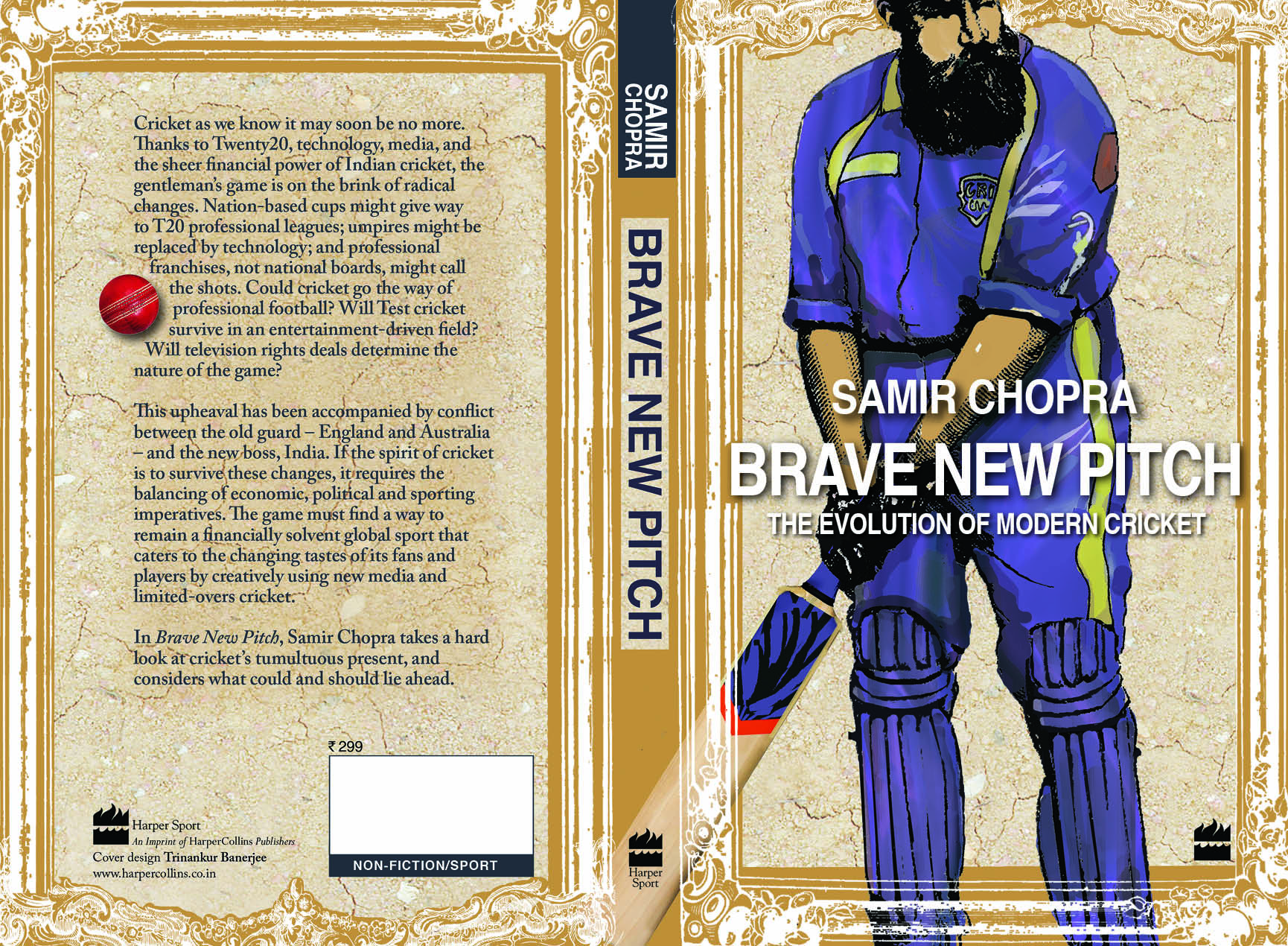
Book Release Announcement: Brave New Pitch: The Evolution of Modern Cricket

As some readers of this blog might be aware, I write on cricket (the sport, not the animal), at my blog The Pitch, on ESPN-Cricinfo. My first book on cricket, Brave New Pitch: The Evolution of Modern Cricket has just been released by HarperCollins.

The blurb for it says:

Cricket as we know it may soon be no more. Thanks to Twenty20, technology, media, and the sheer financial power of Indian cricket, the gentleman’s game is on the brink of radical changes. Nation-based cups might give way to T20 professional leagues; umpires might be replaced by technology; and professional franchises, not national boards, might call the shots. Could cricket go the way of professional football? Will Test cricket survive in an entertainment-driven field? Will television rights deals determine the nature of the game? This upheaval has been accompanied by conflict between the old guard England and Australia and the new boss, India. If the spirit of cricket is to survive these changes, it requires the balancing of economic, political and sporting imperatives. The game must find a way to remain a financially solvent global sport that caters to the changing tastes of its fans and players by creatively using new media and limited-overs cricket. In ‘Brave New Pitch’, Samir Chopra takes a hard look at cricket’s tumultuous present, and considers what could and should lie ahead.

That’s quite a mouthful, or two. What’s the book about, and why should non-cricket fans be interested in it? Well, among the most important of the changes noted above has been the introduction of a new format, Twenty20, which brings a telegenic and entertaining form of the game to a larger audience, and a new professional league, the Indian Premier League (IPL). Between these two, the game of cricket might be changed forever. They will have this effect because they change the political economy of cricket: they change its wage structure and make possible a brand new labor market.

The first change has already given cricket players an alternative career playing only the shorter formats of the game; the latter change is perhaps the most interesting consequence of the change from cricket being a nation-based sport to a club-based sport.  Twenty20 made possible a new professional league and now that league, and others like it, who have noticed its financial success (and its mistakes) make it possible to think about club-based versions of the game becoming predominant. Players and boards have already clashed over their differing commitments to the game; these can only be expected to increase, especially as the current nation-based forms of the game are not as conducive of a growth in the professionalization of cricket and its ability to take hold in new territories. Where and how players will want to play and what and who fans will want to watch will, of course, have the final say in these matters.

These two changes, underwritten by a massive reliance on television rights deals, are complicated by their association with the sport’s dominant financial power: India. India’s influence on the world of cricket is disproportionate, and often, the cause for friction. As a result, the game lurches toward its future, riven by persistent conflict between its stakeholders: the various national cricket boards, the fans, the players, the media. Accusations of greed, incompetence, racism, hypocrisy and bad faith fill the air; when the smoke clears in a few years, things could look very different.  This future could be a bright one, if the right kinds of balance are struck.

My book is attempt to examine some of the game’s recent history in order to try to offer my prognosis for the game’s future. Writing a book about a rapidly changing subject has not been easy; my fervent hope is that I’ve captured the most essential aspects of what lies ahead.

Note: Brave New Pitch is now available at Amazon  and at Flipkart (for Indian readers). An e-book version should be out very soon.

The Snowtown Murders: John Bunting and his Barrels

Snowtown (aka The Snowtown Murders) is one of the most difficult movies I’ve ever seen. It took me three viewings to finish watching it: I called the first one off because the accumulated horror and dismay had become too much; I restarted it hours later, stopped again after a few minutes, and then finally, on the third viewing, went all the way to the end. I was apprehensive about starting the movie again and was relieved, very, when the closing titles began. So, Snowtown is a hard movie to sit through. Is it any good? Answering this question seems to be required of anyone that writes on it, so let me answer with a brief ‘Yes.’ Indeed, I might watch it again. That won’t make it any easier though.

Most notably, Snowtown is as brutal as it is because the series of killings that are the subject of the movie are enabled by human manipulation. Wills are broken before bodies are; this is the story of those who kill, and those who help them kill. And this is why the image of Jamie Vlassakis, who was convicted of four of the eleven ‘Snowtown murders’ with John Bunting, is portrayed so prominently on the movie’s posters: Bunting  had accomplices, those that he talked into aiding him in his horrific acts, those that found, in aiding Bunting, some way of connecting with a world they felt themselves cut off from. Their manipulation is as much centerpiece of the movie as the murders and can be just as disturbing. There aren’t any happy endings in the movie, those that could make any of this manipulation worthwhile.

There is overt violence in Snowtown: stranglings, torture and rape. But there is violence of another kind too, that of verbal manipulation and abuse, the slow, relentless, corrosion of lives–humans can not just terminate other humans’ lives but also distort and warp them. Movies about serial killers are, at their best, deeply unsettling glimpses into a netherworld of psychological affliction and pathology, one in which standard conceptions of our fellow humans fail to find purchase. But their effectiveness relies on their portrayal being realistic enough to engage us  so that we cannot merely mock them as monsters through the bars of their cages. What makes Snowtown work is the almost-documentary-like feel of a particular kind of modern suburban life, documents we’ve seen before and come to associate with the pathology on display: the slow, decaying tableaux of video games and televisions in frumpy living-rooms, of grim supermarkets and small-town streets, and most of all, the seemingly aimless, yet chilling, conversations that animate them.  (Every good director devises a palette of colors all his own; Snowtown’s Justin Kurzel employs a ghastly grey and dark scheme that works as a visual metaphor for the slow bleaching out of life). One of the most horrifying thoughts triggered by Snowtown is that our modern lives and worlds are full of settings like these, theaters in training for the acts showcased here.

Flying Solo, As Author, For a Change

Sometime this week or the next, my fourth book, Brave New Pitch: The Evolution of Modern Cricket (HarperCollins India 2012), will make its way to bookstores and online book-sellers. My fourth book differs in one crucial regard from those that have preceded it: I have not co-authored it with anyone; its jacket lists but one name, mine, as the author. (Summing up, the blurb says: ‘In Brave New Pitch, Samir Chopra takes a hard look at cricket’s tumultuous present, and considers what could and should lie ahead.’)

This is a novel feeling, a journey to a strange land. Flying solo?

I like collaborators. Not dastardly Vichy-types but the diverse set of co-authors that have brought my writing projects,  thus far, before Brave New Pitch, to fruition. While working on my doctorate I carefully managed my awe of my Putnam Prize-winning adviser while drawing upon his genius to help me navigate the complexities of mathematical logic. My dissertation–on new models of belief revision that accommodated inconsistent beliefs and relevance-sensitivity–bore my name on its spine but the stamp of his exacting attention to detail.

And then there was the military aviation historian whom I did not meet until after the publication of our book (a history, the first, of the India-Pakistan air war of 1965).  We talked on the phone and generated a blizzard of emails (he lived in India, I in the US and Australia); his presence was always palpable in constantly redefining my notion of good history. We used no sophisticated file sharing software; we simply maintained a repository of book chapters, and sent the other an email when we edited a file. It worked; somehow, at the end of it all, we had a book, a good one.

Later, while working on a book about the liberatory potential of that gigantic collaboration called the ‘free software phenomenon’,  I found a co-author four floors down from me; we went biking, drank beers, went on double-dates, and squabbled endlessly over writing. Every single sentence was negotiated, an exhausting experience essential to the form and content of the final work. We stored our files online, worked on them together. And I mean ‘together’; we put four hands on the keyboard, and miraculously, managed to write that way.

Later, while working on a book on how current legal theory could and should accommodate artificial agents, I negotiated with a collaborator who often preferred long periods of autonomous activity in isolation. For the first time, I used software for writing collaboration; it wasn’t perfect but it introduced some much-needed structure to the writing process. I became an expert at change-tracking software; I became used to repeated iterations and pass-throughs of chapters in response to close readings by my co-author.

I’ve negotiated many power relationships in these partnerships; from dissertation advisers to good friends (deleting either’s sentences requires sensitivity and tact). Each collaborator has enriched and complemented me, and, in becoming part of my cognitive resources, has been an essential agent in my self-realization. The muses only visit while we work; mine include my collaborators.