Ross Douthat the Slippery

Ross Douthat is a very slippery customer. There is just no getting around it. It’s this slipperiness, no doubt, that earns him the appellation of being a ‘thoughtful conservative’ i.e., not a foaming-at-the-mouth wingnut. His latest Op-Ed is a classic instance of this well-greased slipperiness.

It is ostensibly a critique of Republican tactics in the ongoing, entirely ludicrous fiasco engineered by the most extremist faction of the party:

[T]here is…something well-nigh-unprecedented about how Republicans have conducted themselves of late. It’s not the scale of their mistake, or the kind of damage that it’s caused, but the fact that their strategy was such self-evident folly, so transparently devoid of any method whatsoever.

Every sensible person, most Republican politicians included, could recognize that the shutdown fever would blow up in the party’s face. Even the shutdown’s ardent champions never advanced a remotely compelling story for how it would deliver its objectives. And everything that’s transpired since, from the party’s polling nose dive to the frantic efforts to save face, was entirely predictable in advance.

But there is no shortage of apologia in it nevertheless.

For instance, the classic ‘pox on both your houses’ coupled with the ‘it ain’t so bad’ moves:

Politics is a hard business, and failure is normal enough. It’s not unusual for political parties to embrace misguided ideas, pursue poorly thought-out strategies, persist in old errors and embrace new ones eagerly.

So we shouldn’t overstate the gravity of what’s been happening in Washington. There are many policies in American history, pursued in good faith by liberals or conservatives, that have been more damaging to the country than the Republican decision to shut down the government this month, and many gambits that have reaped bigger political disasters than most House Republicans are likely to face as a result.

 Some strange analogies:

[I]magine an alternate reality in which figures like Joe Lieberman and John Kerry were stuck trying to lead a Democratic Party whose backbenchers were mostly net-roots-funded fans of Michael Moore, and you have a decent analog for where the post-Bush Republicans have ended up.

The touching faith in the idea, still, that the Tea Party is a true grass-roots movement and the source of policy ‘innovation’, and one that, pardon my French, actually gives a flying fuck about the middle-class:

Republicans need to seek a kind of integration, which embraces the positive aspects of the new populism — its hostility to K Street and Wall Street, its relative openness to policy innovation, its desire to speak on behalf of Middle America and the middle class — while tempering its Kurtzian streak with prudence, realism, and savoir-faire.

Nothing else quite makes me snicker as much as this refusal to note that it is still big money that drives the Tea Party, that its so-called policy innovation is mostly either rehashes and variants of old, discredited, stale Republican ideas or, classical progressive ideas, cleverly co-opted.

But as my intemperate language above shows, what’s really bothersome about Douthat’s apologia for the Mad Hatters is his insistence that they have the interests of middle-class Americans–and some nebulous entity called ‘Middle America’–at heart. This refusal to peer into the quasi-fascist heart of the Tea Party is what ultimately gives the game away.
The Burdens of Proofreading and Copy-Editing

There must be some sort of writer’s law out there that captures the sensation I am about to describe: as your book approaches the finish line, and as the final proofreadings, corrections, indexing queries, and debates about jacket and cover compositions pile up, the author’s nausea at the sight of his former ‘dearly beloved’ increases in direct proportion.

I have described this sensation before:

[W]eary and exhausted by the endless redrafting, polishing and proof-reading, I want only to be done with the damn thing. It’s not as if I’ve considered the ‘product’ then to be complete; rather, it is that I cannot summon up the energy for another painfully close and exacting edit. (Months later, when I look at the submitted version, I’m astonished by how much dross I let get by me.)

Or:

[C]opy-editing is hard, tedious work, of course, leaving behind many a scar worn in by memories of endless, iterative checks.

That moment is upon me again. My co-author, PVS Jagan Mohan, and I are now getting close to the final production stages of the first volume of our history of the air war component of the 1971 Liberation War for Bangladesh. (This is the second book we have worked on together; the first was a one-volume history of the 1965 air war between India and Pakistan). The book has been eight years in the making and I can’t wait for it to be over. The lion’s share of the work has been done by Jagan, but I’m still exhausted. I can’t imagine how he feels.

As is evident, I do not enjoy this process of ‘finishing’ a book, so much so that in the past, I have suffered from anxiety-ridden dreams about it. There is always, in these closing stages, a particularly insidious fear: that the process of revisions will never end, that I will be stuck, making revisions and emendations, caught in a perpetual loop of sorts, never seeing a sentence, a paragraph, a page, a manuscript come to fruition. Writing is a series of hurdles; this last stage, just like the first one, feels like the hardest. (Well, there’s those middle stages too, when you doubt the wisdom of ever having started the journey.)

Nothing makes copy-editing and proofreading less tedious. This morning, I have played classical music and electronica as sonic accompaniment; they offer only partial solace; they won’t do the reading and corrections for me; they won’t make the act of reading these four hundred odd pages for the umpteenth time any easier. I have, of course, sought relief in distraction: perhaps Facebook, perhaps Twitter, perhaps more sensibly, a little play-time with my little daughter.

Somewhere in the distance, because of the presence of the PDF file of the final proofs resident on my desktop, I can sense the final finished product: a slick paperback with an artfully designed cover, my name on its spine. But it’s still distant, and I feel overcome, again, by a curious mix of tedium and anxiety.

This thing, this beast, is supposedly a virtual intangible thing, an electronic file. But as I crawl toward the finish, it weighs on me like something far more corporeal.

Social Networks and Loneliness

As a graduate student in the late 1980s, I discovered, in quick succession, email, computerized conferencing, and Usenet newsgroups.  My usage of the last two especially–and later, the Internet Relay Chat–would often prompt me to say, facetiously, that I would have finished my graduate studies quicker had I stayed off the ‘Net more. That lame attempt at humor masked what was a considerably more depressing reality: staying online in the ‘social spaces’ the early ‘Net provided was often the only way to deal with the loneliness that is an inevitable part of the graduate student’s life. The emailing quite quickly generated frantic, incessant checking for the latest dispatches from my far-flung partners in correspondence; the conferencing–on the pioneering EIES–led to a full immersion in the world of conference discussions, messaging, live chatting; Usenet newsgroup interactions developed into engagement with, and entanglement in, long-running, fantastically convoluted disputes of many different shadings; IRC sessions generated a cluster of online ‘friends’ who could be relied upon to engage in long conversations at any time of the day or night.

All of this meant you could be distracted from classes and reading assignments. But that wasn’t all of it obviously; an often denuded offline social life was given heft by the online variant. There is something curiously ironic about the need for ‘filling up’ that is implicit in that statement: my daily life felt hectic at the best of times. Classes, assignments, campus employment, all seemed to occupy my time quite adequately; I fell all too easily into that classic all-American habit of talking loudly about how busy I was.

And yet, tucked away in the hustle and bustle were little singularities of emptiness, moments when the crowded campus would appear deserted, when every human being visible seemed surrounded by an invisible protective sheen that repelled all approaches. Into these gaps, thoughts of lands and peoples left behind all too easily intruded; into those interstices flooded in an awareness of a very peculiar distance–not easily characterized–from all that seemed so physically proximal. (That mention of ‘lands and peoples’ notes, of course, what was significantly different about my experience; I was voluntarily displaced, an international student.) These turned what could, and should, have been solitude, into just plain loneliness.

Those early days of refuge-seeking in the electronic and virtual spaces made available by the social networking tools of the time left their mark on me. They turned an already easily-distracted person into an often decohered mess of  competing impulses and emotions: a low-grade anxiety and impatience being among the most prominent of these. (I have often waxed plaintive on these pages about the distraction I suffer from; no cure seems forthcoming.)

As is perhaps evident, I don’t remember those days with any great fondness: to this day, bizarrely enough for a professor, I am made uneasy, not ecstatic, by the sight of students working late in libraries or laboratories, peering at computer terminals (as opposed to books, I suppose). And every Facebook or Twitter status that is an all-too poorly disguised plea for companionship generates an acute sympathetic response.

The times, I am told, are a-changin. But some things remain just the same.

American Horror Story and Torture Porn

Last night was Fright Night. I had plans to watch the opening episode of the third season of American Horror Story, a show that despite its disappointingly concluded first season and its at times too-lurid second season still manages to hold considerable promise for me. But I was going to watch Paranormal Activity first; somehow despite the hype, I’ve managed to not see this 2007 sleeper hit.   Watching a commercial-separated movie isn’t great, but it was going to run on F/X from 8-10, at which point American Horror Story would kick off.

Two hours later, after I had finished Paranormal Activity, I was only able to stay awake to catch the opening scenes and title sequence of American Horror Story; the rest was DVR’d for another day. But by then, I had already had occasion to encounter yet another instance of a familiar and problematic aspect of modern horror cinema: torture porn. (The Saw and Hostel franchises made torture-porn a talking point, enough of one to inspire a satirical short video in response; American Horror Story flirted with it in the second season.)

The Wikipedia entry for ‘torture porn’ is filed away under ‘splatter film; this, and the titles listed there suggest a broader understanding for the term that I have in mind. I take ‘torture porn’ to implicate those scenes, story lines, and plot devices that rely explicitly on torture carried out on captives (I’m suspect women are the majority of these prisoners.)

In this form ‘torture porn’ relies on scenes of extreme cruelty inflicted on helpless subjects. It is the contrast of maximal power with minimal that unsettles us so, tapping into primeval fears of inefficacy in the face of a variety of forces: natural, political, economic, animal. In the face of sadistic exertions in those domains, we sense we would experience fear and pain only dimly imagined, the kind that would transform us into whimpering, gibbering cowards, begging for mercy;  its cinematic depictions are then, bound to be disturbing to all but the deeply desensitized.

Torture porn can afford to be simplistic in its work. There is little to no suspense, no build-up of supernatural tension; there is little need for supernatural agencies; indeed, most torture porn relies on humans to do the dirty work – on other humans. Which, of course, is what makes it so disturbing: stories of torture are part of our histories, modern and ancient, and there is no evidence our species has grown any less fond of it over the years. Torture porn might thus enable the blending of two genres of cinema, sometimes taken to be distinct: true-crime and horror. For instance, Snowtown, the story of the John Bunting murders in Australia, could be reckoned a torture porn movie. (It is perhaps a little too sophisticated for that, but still my drift should be clear: torture porn enables us to see how horror lurks in the human.)

Is torture porn morally problematic? That is a large and complex question but at the least, I think many of its offerings are just plain lazy, unwilling to do the hard work of story writing, editing, and atmosphere creation that is usually required to effectively and scarily bring horror to the screen.  That’s as big a sin as any.

Note: Paranormal Activity is a very effective little shocker of a movie; with no torture required to creep us out.

The Never-Ending Angst Over the Nobel Prize In Literature

Ian Crouch asks why more Americans don’t win the Nobel Prize for Literature. (The last one to do so was Toni Morrison in 1993, an award I remember especially clearly because a) I had only recently started reading her and b) I was struck by the fact of an African-American woman writer being so recognized.)

This sort of discussion seems vaguely familiar to me: worries about whether the Nobel committee–a bunch of Swedes!–is deliberately resisting an ever-threatening global American hegemony and/or rubbing American noses in it by selecting year after year, ‘obscure’ writers and poets that Americans will be unfamiliar with; vague condemnations that ironically flirt with narrow-mindedness themselves while indicting the American literary scene of provincialism and parochialism; suspicions that the Nobel Prize is awarded to those literary works that are, for some reason or the other, simply not produced by American writers; and so on. (These discussions are distinct from the usual dismayed and disbelieving, ‘Can you believe X was never awarded/Y hasn’t yet been/Z has been nominated for/ the prize?’)

This buzzing mass of speculation, confusion and half-baked theorizing is inevitable: first, we are talking about a Prize, and second its being awarded for Literature. (The money associated with the Nobel Prize does its bit but, really, it’s the hype that does most of the damage.) Judging writers by panels was always going to generate this sort of discussion. If prizes for physics can engender as much controversy as they have, then literature should be even more productive.

The good news for Crouch is that if an American doesn’t win this year, he can just republish the same piece next year.

Note: The most entertaining part of the Crouch piece comes in the comments, where a cranky gentleman writes:

It startles me to find that some people believe America to be a literary powerhouse.  My impression is that 95% of the material to be found in bookstores, or in lists of prize winners, was all written by the same person who had spent too many years at the University of Iowa Writers’ Workshop.

Truth is, the literary industry today aims its products primarily at semi-educated urban feminist careerists who adhere to the current liberal dogmas while employing a demotic prose that reads as if it were dictated by a 35-year-old woman with a Northeastern degree while she lies soaking in warm bathwater.

Do this – go to your nearest bookstore, pick up some highly praised post-modern novel, open said book, and read just the first page.  Do this ten times with ten different novels, and then swear to me on your life that they were not authored by some adept, or some inept I should have said, piece of software. Because that’s where the money is, at the most congested segment of the Bell Curve.

I once asked an editor if William Faulkner could be published today, assuming he weren’t already famous.  “Certainly not,” she said.  “No one would publish him today, and if someone did, no one would read him.”

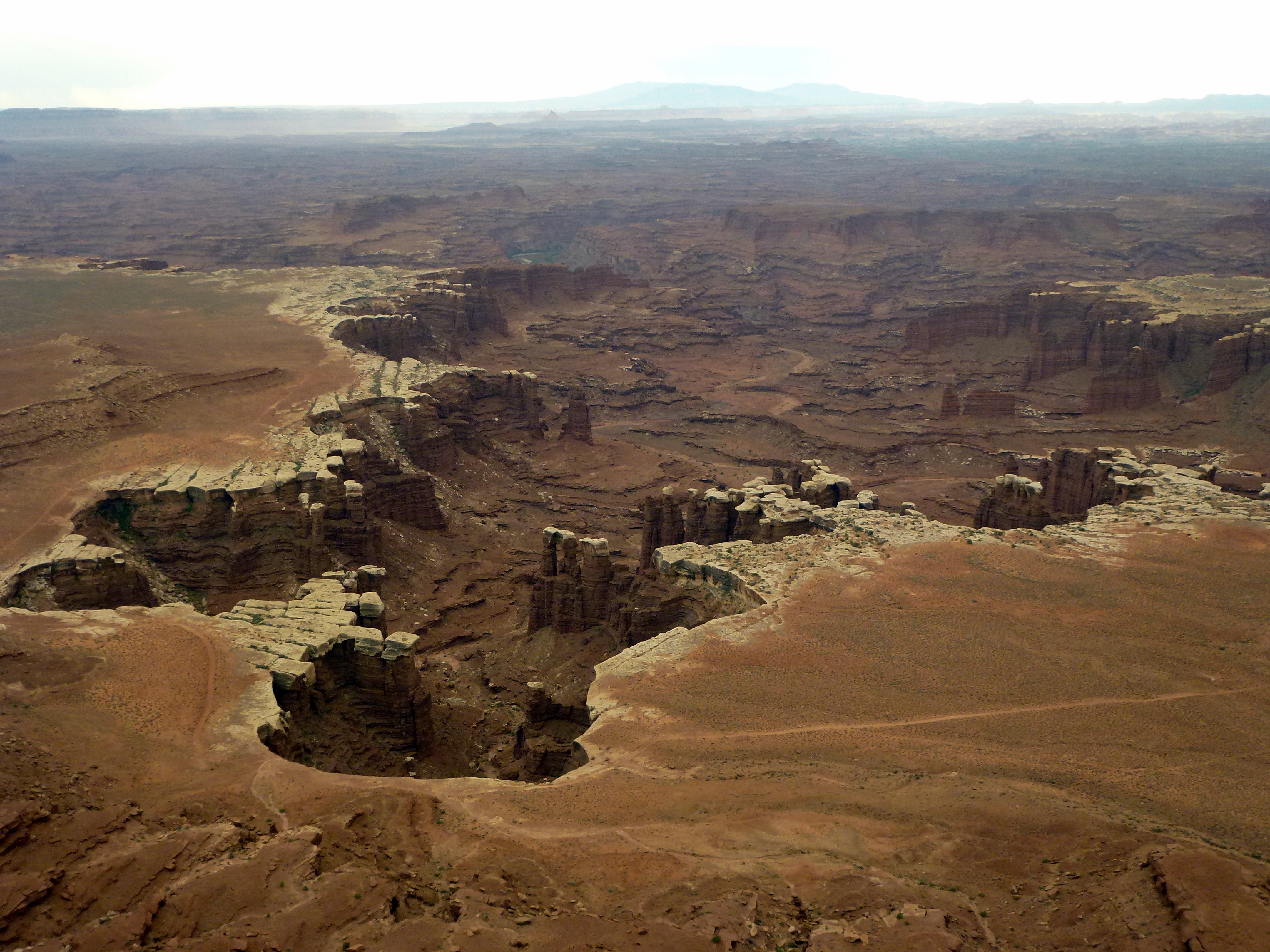
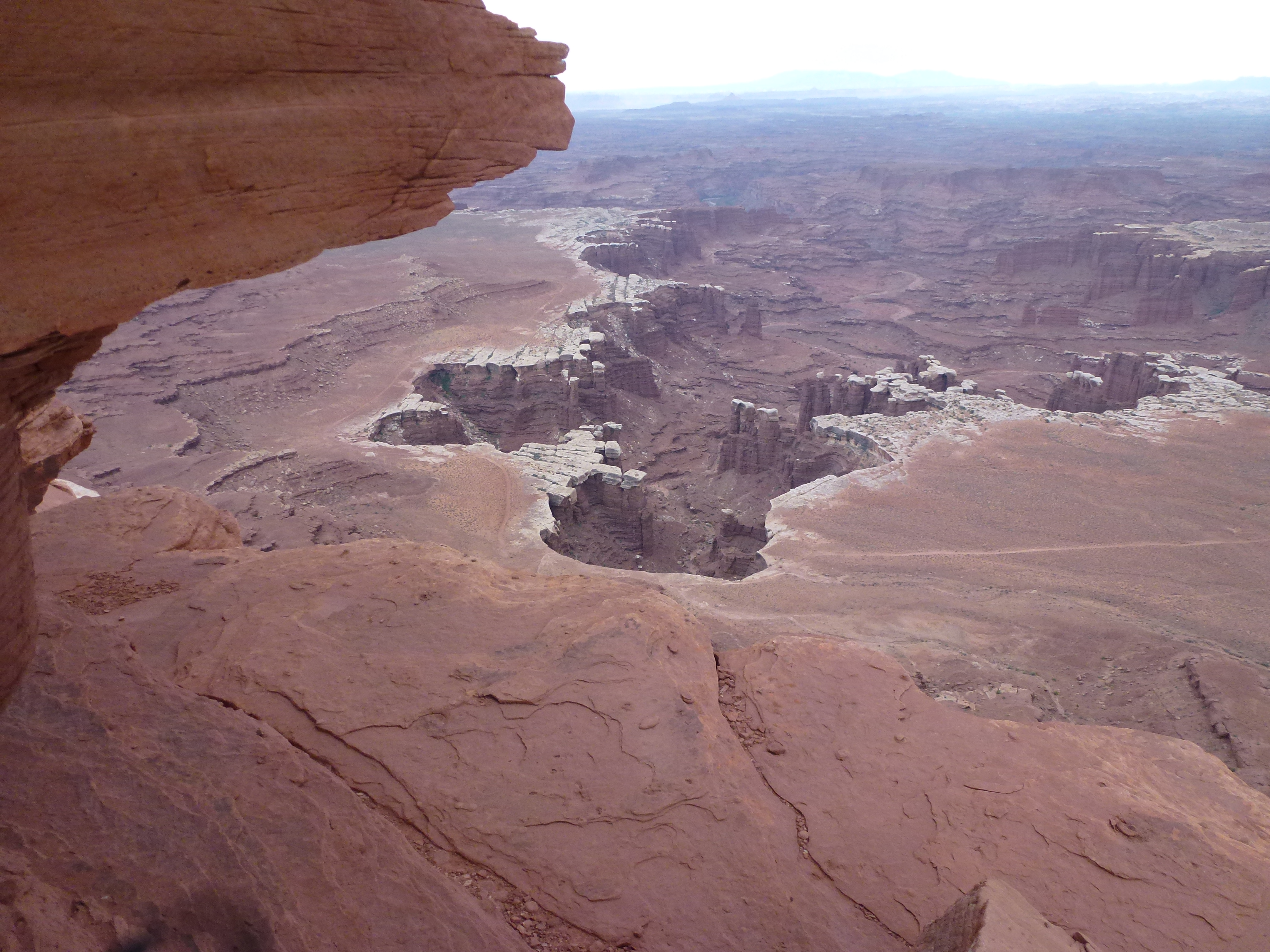
The White Rim Overlook in Canyonlands National Park

Last August, my wife and I visited the Canyonlands National Park in Utah. We had driven to Moab the day before and put ourselves up in a small motel on its outskirts. A day’s hiking in Canyonlands lay ahead; we planned to spend in it the park’s elevated northern Islands in the Sky section, taking in the many magnificent views of the canyon overlooks that supposedly awaited us.

The National Park Service does not lie; the views of the park’s deep and wide canyons, carved out by the Colorado River, were as majestic as promised. The following photographs of the White Rim Overlook portion of the Canyonlands offer only an exceedingly small glimpse of the wonders on display; whatever their virtues of representativeness or typicality my reasons for selecting them lie elsewhere, in the very particular responses they elicited in me at the time I encountered them. [Click on the images for a larger view.]

P1020184

P1020197

We came upon these sights late in the day; it had been a hot one, baking the stony, thorny, scrubby, landscape several shades darker of its already dramatic bronze and making our short hikes earlier desperately thirsty ones. As the evening progressed and the sun moved to the west, seeking shelter after after a hard day’s riding through the sky, the winds picked up, and a host of dramatic clouds moved in. If we were lucky, we’d see–along many different spots on the White Rim’s overlooks–a spectacular sunset and storm all at the same time.

And yet, even with the safety of our car comfortably at hand, and civilization easily accessible, a gathering storm out in the southwestern desert wilderness can still provoke a measure of anxiety: nature seems so unbridled, so unhinged. Who knew, out here in this desolation, what wild forces might not be let loose, the kinds that cared little for human arrangements and concerns?

The storm threatened, blustered a bit, sent down a few raindrops and some vigorous gusts of wind; then, inexplicably, it withdrew. While it gathered its remnants about itself and blew its innards out, we waited it out. I drank some wine from a bottle in a cooler in the car’s trunk; the ice had survived and done a smooth number on the wine.

Then, the wind still gusting about us, we explored the White Rim through a series of walks. The canyons were cavernous, deep, their walls forbiddingly steep and craggy. I marveled at the geological history, the aeons of patient, persistent work done by wind, ice, water, snow, and sand all laid visible to the human eye. Even from a safe distance I could sense my giddy vertigo stir; I knew I would have been hopeless along the rim’s edges.

There is little hope of a photograph capturing the mood: the inexplicable mix of wonder, awe, and fear that is generated by one of the desert’s immense works, its barest particulars effortlessly outstripping our evoked sense of astonishment and delight.

The light faded soon thereafter, ringing a dark curtain over the White Rim. But the images of the day stayed; some on digital storage, others in memories.

Dawn Powell on ‘Writers of Consequence’

Dawn Powell‘s A Time To Be Born is chock-a-block with wonderfully acerbic observations: on life, love, politics–you know, the usual stuff–but for my money, most memorably, in these brief passages, on journalism, writers, and writing itself:

Every morning Miss Bemel turned in a complete digest of the dinner conversations or chance comments of important officials who had visited the house. Miss Bemel had all these words down in shorthand in her unseen chamber outside the dining or from invisible vantage grounds elsewhere in the house, and these were then checked with other information, and eventually woven into the printed words as the brilliant findings of Amanda Keeler Evans. Miss Bemel saw nothing the matter with this arrangement, since her own rise to power accompanied her mistress’ ascension.

To tell the truth, Amanda would have been genuinely surprised to learn that any writer of consequence had any other method of creation. There were a number of minor scribes on liberal weeklies who were unable to afford a secretary, that she knew, but she had no idea that his was anything more than the necessary handicap of poverty. The tragedy of the attic poets, Keats, Shelly, Burns, was not that they died young but that they were obliged to by poverty to do all their own writing. Amanda was reasonably confident that in a day of stress she would be quite able to do her own writing, but until that day she saw no need, and in fact should a day of stress arrive she would not be stupid enough to keep to a writing career at all, but would set about finding some more convenient means of getting money.

Even if the public had discovered, through malicious enemies, that Amanda’s first knowledge of what she thought about Britain’s labor problem, Spanish Rehabilitation, South American Co-optation, America First, War with the Far East. was the moment she read Miss Bemel’s “report” above her own signature, no one would have thought the less of her intelligence, for the system was blessed pragmatic success. The most successful playwrights, the most powerful columnists, the most popular magazine writers, seldom had any idea of how to throw a paragraph together, let alone a story, and hired various little unknown scribblers to attend to the “technical details.” The technical details usually consisted of providing characters, dialogue and construction, if the plot was outlined for them, as well as the labor of writing. Sometimes the plot itself was assembled by this technical staff, for individuals were far too busy in this day and age to waste time on the petty groundwork of a work of genius; it was enough that they signed their full name on to it and discharged the social obligation attendant upon its success. The public, querulous as it was with the impractical gyrations of the unknown artist, made up for this, by being magnanimously understanding of the problems of the successful man, so it all evened up in the long run. Amanda was just as entitled to her “genius” as any of the other boys on Broadway or in the public prints.

The Peculiar Allure of Blog Search Terms

Like most blogging platforms WordPress provides statistics on blog views: unique visitors, referring pages, and most interestingly search terms that bring viewers here.  The following, for instance, are yesterday’s entries for this blog:

a municipal report what is the narrator’s attitude toward the south
failure of kindness
www american horror story season 3 walking dead
is it better for a jewish boy to be atheist or christian?
why i’m a pakistani first and punjabi second
what to put on professor door
brave announcement
bruce springsteen new york times op ed
nietzsche walter white
martin buber adolf eichmann

(A little game that may be played almost instantly on reading such a list is to try to guess which posts my visitors would have been directed to via the terms above. In the case of the list above, I can guess correctly in each case.)

I am not the first blogger to note that search terms are fascinating. On her blog, Elke Stangl has an entire series of interesting posts on search term, spam and error message ‘poetry’. Here is an interesting entry in her oeuvre:

spam poets
write weird things for search terms
crowdsourcing next level
work hard play hard
post modern art
narrating events

text editor blank sheet paper
gay steampunk costumes
a theory about nostalgia
theory of poetry satire
to flush the toilet

how do an gyroscope work? magic?
spinning top with helium balloon
gyroscope not falling over
patent perpetuum mobile
controlling the elements
cliche physics problems
gyroscopes are magic

zen engineering
subversive element
42 divided by 3
retro geek

how to combine theory with practice in physics
microwave oven radiation wavelength holes
40 below summer fire at zero gravity
can mice get into microwave oven
dead mice in the microwave
microwave oven theory
physics isn’t intuitive
pseudoscience

Our fascinated engagement with search terms is triggered by a variety of factors. Sometimes it is just the  fractured syntax, an inevitable byproduct of the urge to be efficient in the framing of the search; sometimes it is the giggle-inducing revelation that your blog contains material that brings porn-seekers to it, which also serves as a reminder of how parental and governmental confidence in porn filters is misplaced; sometimes it is the glimpse provided of the anxious student–whether high-school or college–seeking online help with a writing assignment;  sometimes the idiosyncratic connections made visible–as in the ‘nietzsche walter white’ exhibit above.

Most of all though, search terms are a glimpse of the hive mind of the ‘Net: a peek at the bubbling activity of the teeming millions that interact with it on a daily basis, seeking entertainment, amusement, edification, gratification, employment.  They make visible the anxiety of the questions that torment some and the curiosity–sometimes prurient, sometimes not–that drives others; they remind us of the many different functions that this gigantic interconnected network of networks and protocols plays in our lives, of the indispensability it has acquired.

They reassure us too, that perhaps even something quite as humble as a search term that we type into a search engine may amuse and edify someone, someday.

Lech Majewski’s The Mill and The Cross: A Beautiful Moving Tableaux

The Mill and the Cross, Lech Majewski‘s 2011 film, like Pieter Bruegel the Elder‘s The Procession to Calvary, the painting that inspires it, is beautiful to look at. It might be hard to know what to make of it in a conventional movie-viewing sense, but the cavalcade of gorgeous images that it parades before our eyes very quickly convince us that we’d do better to just let our visual senses be ravished. And our moral sensibilities sometimes shocked, for human cruelty is on display too. It is the melding of beauty and cruelty that is pulled off with much aplomb in Bruegel’s classic work, and to Majewski’s credit, he achieves a similar synthesis in his.

Bruegel’s masterpiece features almost five hundred characters arrayed on a typically sprawling, panoramic canvas; Majewski’s cinematic recreation concentrates on a dozen or so of these.  The setting is sixteenth-century Flanders and Spanish militia are in the mix, prosecuting, with great cruelty, the local Protestant peasantry, who seek only, like ‘commoners’ the world over, to go about their daily business. There is a cross; later there will be two more. The mill stands above it all, towering up and away into the skies; it is the provider of grain and sustenance to the tableaux at its feet. The soldiers below bring death and pain to the peasants. Children play, mothers fret, animals graze.

It all sounds very sparse, and yet, by careful attention to detail, Majewski brings to life the beauty of the everyday and the mundane. The colors and textures of fabric, earth, wood, food and water, the daily objects and materials that surround the movie’s characters, are sumptuous and startling. They tickle our sensibilities in much the same way that an artwork’s does.

The artist and his patron survey the scene before them; the former sketches the outlines of the masterwork, the latter seeks clarity on the process. There is very little dialogue; viewers short on patience will not be amused. Almost all of it is spoken by the artist at work; these insights into the creative process are revealing and edifying.  And then there is the thrill of watching an artist’s hand bring, through quick expert moves that stroke and brush, an inner vision to life.

Roger Ebert concluded his review of The Mill and the Cross with the question: ‘Why must man sometimes be so cruel?’ It is a question that should occur to anyone that watches this movie: there are crucifixions, beatings, burials alive, whippings, all handed out with a disturbing indifference. That old cliché–man’s inhumanity to man–springs to our lips.  The crucifixion of the ‘Savior’ should bring to mind tales of Romans and Jews, but here it is Catholics and Protestants: the characters change, the cruelty persists.

A great artwork is so, because it endures over time and makes itself available for reinterpretation to generation after generation, no matter where, no matter when. The Procession to Calvary is one because we can imagine the scenes depicted in it in our time as well: persecution, indifference to suffering, the sorrow of a mother for her dying child.

The Mill and the Cross is a spirited cinematic aspiration in the same vein.  

The US Government Shutdown: Party Like It’s 1995

America awoke this morning to find its government shut down, thanks to Congress’ failure to pass a funding bill. Eight hundred thousand federal workers–including my wife, a staff attorney at the National Labor Relations Board–will be furloughed today. (My wife will go in for the first four hours to carry out an orderly shutdown of the agency’s services.) Elsewhere, all over the country, government services will be curtailed to varying degrees.  If the ‘fiscal impasse’ continues, matters could worsen:

By Oct. 17, Congress must raise the nation’s debt limit to pay for bills already incurred or provoke a globe-shaking default.

And all of this is the consequence of an utterly misguided effort to repeal a piece of legislation–promised by a twice-elected president–that is the law of the land: passed by the House of Representatives and the Senate, and upheld by the US Supreme Court in the face of numerous legal challenges.

The members of the Republican Party–now, more than ever, utterly beholden to the American fascist fringe–who have engineered this fiscal disaster have spoken glibly of carrying out the will of the ‘American people.’ Their confusion is never more starkly on display than when they invoke this term. They seem to care little for those who elected Barack Obama, for those whose representatives voted for the Affordable Care Act (ACA) in two legislative bodies; they seem to care little for the American constitution, in light of those provisions this act emerged as appropriately constitutional. They remain fixated instead, on their indefensible ideological convictions, for the sake of which they are willing to deny hundreds of thousands of American’s their wages, and to deny millions others their services.

I’m not sure what language to use to describe those members of the Republican Party who have decided that this is the correct way to wage their battle against the ACA.  And neither am I entirely sanguine that they will face an electoral backlash; after all, these are elected members of the US House of Representatives, who were voted into power on the basis of an electoral manifesto that promised as much sand in the wheels of the US government as possible.  The vulnerability of the US constitution to acts of political hijacking like this, if it wasn’t already manifest in the first Clinton and Obama terms, are even more manifest now.

The tragedy of modern American political life is that real radicals are not in the streets, seeking real, systemic change in a broken, corrupt, system, one beholden to Wall, not Main, Street; instead, another variant is in power, dedicated to making sure that millions of Americans cannot secure healthcare. It all sounds like a bit of a cruel joke, and I really wish it was, but it isn’t.

Note: A brief accounting of our personal costs thanks to this shutdown: my wife faces an indefinite furlough; we have already paid for this month’s daycare so it might all be money down the drain. We are, however, not too badly off compared to many other Americans. For the time being.